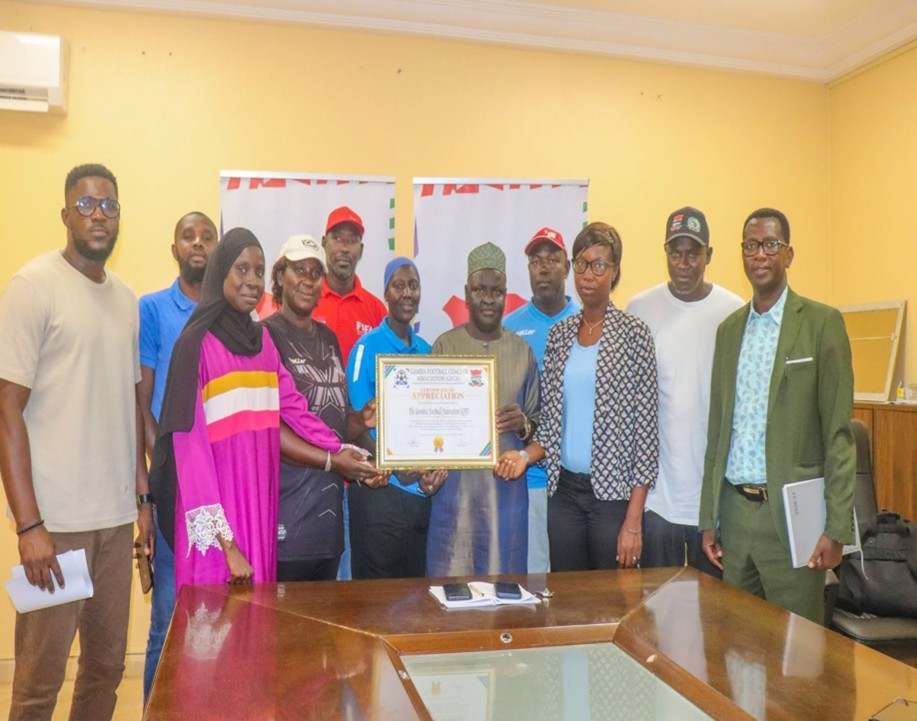
The executive committee of The Gambia Football Coaches Association visited The Gambia Football Federation President Kemo Ceesay at the Football House in Kanifing. This meeting served to discuss strategic development initiatives for the sport within The Gambia. During the session, Kemo Ceesay addressed the group regarding their role in the advancement of national football. He identified "coaches as the most critical stakeholders in the game" while acknowledging the contribution of the association to local technical standards. The discussion centered on aligning the objectives of the coaches with the broader administrative goals of the federation. Both parties reviewed current training requirements and organizational priorities to ensure professional growth for practitioners operating throughout the country.
The dialogue focused heavily on the structural needs of the sport, with the executive committee members providing feedback on the challenges faced by technical staff in various regions. By facilitating this direct communication, the federation aims to integrate the expertise of the coaches into its future planning cycles. The participants examined the current state of technical education and discussed how the federation can better support the professionalization of coaching roles.
Vision for World Cup Qualification
GFF President Kemo Ceesay outlined his administration's long-term vision for the national team, which includes qualifying The Gambia for the 2030 FIFA World Cup. This objective serves as a primary benchmark for the federation as it seeks to elevate the standard of play on the international stage. Kemo Ceesay emphasized that reaching this milestone requires a cohesive strategy involving the federation, the coaching staff, and the players. He noted that the administration is committed to providing the necessary resources to ensure that the national team remains competitive in upcoming qualification cycles.
Kemo Ceesay also announced plans to decentralize federation operations by establishing a regional headquarters in Soma. This facility intends to improve administrative reach and provide localized support for football development activities outside the Greater Banjul Area. By moving administrative functions closer to provincial clubs and local associations, the federation expects to streamline communication and reduce logistical barriers for stakeholders operating in more remote regions.
GFF Second-Vice President Bakary Bojang addressed the members of The Gambia Football Coaches Association regarding the necessity of local development. He encouraged the organization to expand its grassroots D-License training programs to reach more participants nationwide. These courses aim to increase the number of certified practitioners capable of identifying and developing talent at the community level. Bakary Bojang noted that the expansion of these certification pathways is essential for building a sustainable pipeline of talent that can eventually feed into the national team structures. The meeting concluded with a commitment from both the federation and the association to continue their collaboration, ensuring that the development of coaches remains a core component of the national football agenda. The leadership of the federation reaffirmed its support for the association’s initiatives, signaling a unified approach to achieving the stated goals for 2030 and beyond.