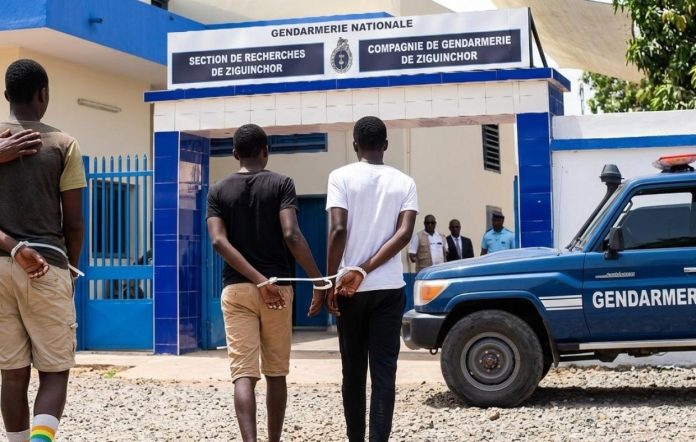
The Ziguinchor prosecutor’s office has remanded 11 individuals in custody in Senegal following their arrest for alleged homosexual offenses. This decision came after the office ruled on the case of 12 people initially detained for these alleged offenses. The ruling by the Ziguinchor prosecutor’s office determined the legal path forward for those apprehended. One of the accused, a nurse employed at Ziguinchor Peace Hospital, was released and subsequently removed from the legal proceedings, indicating a separation of their case from the others. The remaining 11 individuals will remain in custody as the judicial process continues, awaiting further legal steps.
Details of Arrests and Charges
The 11 individuals remanded in custody represent a range of professions, illustrating the diverse backgrounds of those involved in the case. Among them are tailors, shopkeepers, and Batch car drivers. The group also includes a cook, an employee from the telecommunications company Sonatel, and two students. These individuals were formally remanded following the completion of preliminary investigations conducted by authorities. During these initial inquiries, a significant piece of evidence emerged: the mobile phone of one of the suspects was found to contain the phone number belonging to the nurse who was later released. This discovery was a factor in the nurse's initial detention, as it linked them to the broader group under investigation. However, following further examination, the individual was later released from custody and formally removed from the legal proceedings. The thoroughness of these preliminary investigations has now paved the way for the ongoing judicial process involving the remaining 11 individuals, who will face formal charges based on the evidence gathered.
Legal Ramifications and Health Concerns
The 11 individuals remanded in custody face serious potential prison sentences ranging from five to ten years if convicted. This legal consequence is explicitly stipulated under Article 319 of the Senegalese Penal Code, which specifically addresses homosexual offenses. The judicial process will continue for the accused, who, as noted, include tailors, shopkeepers, Batch car drivers, a cook, an employee from Sonatel, and two students. Beyond the legal proceedings, the case has taken on an additional complex dimension: some of the accused have reportedly tested positive for HIV. This public health aspect introduces a critical concern alongside the legal ramifications under national law. The arrests and subsequent remands highlight the ongoing enforcement of existing legislation concerning sexual acts deemed illegal in Senegal, bringing both legal and health issues to the forefront.
Background on Senegalese Law
Senegalese law unequivocally prohibits homosexual acts, categorizing them as offenses punishable by imprisonment. Article 319 of the Senegalese Penal Code specifically addresses these acts, outlining the precise legal consequences for individuals found guilty. Under this article, those convicted of homosexual offenses face potential prison sentences ranging from five to ten years, reflecting the severity with which such acts are viewed legally. This legal framework reflects the country's stance on such activities, which are widely considered taboo and morally unacceptable in the predominantly Muslim nation. The enforcement of these laws has consistently led to arrests and detentions in various parts of Senegal, showing the government's commitment to upholding these statutes. The recent case in Ziguinchor, involving the 11 individuals now remanded, is a direct example of this enforcement. The judicial system processes these cases in accordance with the established penal code, with preliminary investigations leading to remand in custody for further legal proceedings and eventual trial.